

Directionally Challenged Proteins Lead to Eye and Neurological Disease
New research shows that important proteins in the human body need to be positioned correctly at their workstation to do their job. Graduate student Duncan Boren was awarded the 2025 Keegstra and Thomashow Travel Award for this research.
Recreating an Important Moment on the Evolutionary Timescale
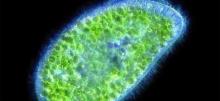
A new project is underway that could help researchers have a better understanding of an important piece of Earth’s evolutionary history. Evidence has shown that the chloroplast evolved 2.1 billion years ago through endosymbiosis, wherein one organism lives inside another.
Biofilms and the Search for Life Beyond Earth
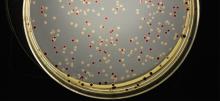
In a study published in Applied and Environmental Microbiology, researchers from Michigan State University explored how some of the planet’s most ancient and resilient life forms, microbial biofilms, survive in extremely harsh environments. These structured communities may hold the key to understanding how life could survive and be detected on other planets.

First Scientific Paper on 3I/ATLAS Interstellar Object
When the news started to spread on July 1, 2025, about a new object that was spotted from outside our solar system, only the third of its kind ever known, astronomers at Michigan State University — along with a team of international researchers — turned their telescopes to capture data on the new celestial sighting.
Davuluri Receives Zeits Fellowship
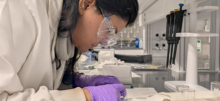
Deepika Davuluri, a graduate student in the laboratory of Professor Katharina Domnanich, has received the College of Natural Science's Alfred J. and Ruth Zeits Endowed Fellowship. This endowment supports work in nuclear and laser science research, and particularly students whose research interests are targeting cancer.

MSU Researchers Develop Wood-Based Material That Improves Safety and Life of Lithium-Ion Batteries
For consumers worried about the risks associated with using lithium-ion batteries — which are used in everything from phones to laptops to electric vehicles — Michigan State University has discovered that a natural material found in wood can improve battery safety while also improving the battery’s life.

MSU Study Unpacks How 2025 Tariffs Shocked Global Supply Chain
In the wake of the largest series of U.S. tariff hikes since 1930, a new study from Michigan State University explores how this economic shock is reshaping global supply chains and offers a framework to help researchers and policymakers make sense of the chaos. The study was recently published in the Journal of Supply Chain Management.

RFID Isn’t Just for Tracking Inventory: New MSU Research Shows It Secures Drug Supply Chain
New MSU-led research shows how real-time tracking using RFID can fight counterfeit drugs, protect patients, and help pharmaceutical companies meet new federal security standards. The breakthrough pilot, led by the Axia Institute, proves RFID’s potential for total traceability, from production to pharmacy.

Researchers Map the Worldwide Threat of Antibiotic Resistance in Livestock Waste
A major international study by Michigan State University and partner researchers has uncovered a hidden danger lurking in animal farms around the world: Livestock manure is packed with antibiotic resistance genes that could threaten human health. This study spanned 14 years and represents the most comprehensive survey of livestock antibiotic resistant genes to date.

O'Dell Publishes Book on Creating Theatre With Neurodiverse Audiences in Mind
MSU Theatre Specialist Dionne O’Dell releases her debut book, The Sense-Ability Ensemble’s Guide to Creating Theatre for Audiences that are Neurodiverse, offering an inside look at building inclusive performances from the ground up. Available July 1, 2025.