

Making a Mark When It Comes to Investing in the Arts as Essential to K-12 Education
MSU integrates the arts into core subjects—math, science, social studies, and world languages—so creativity enhances every lesson. This approach fosters curiosity and joy while helping students strengthen their grasp of both the art form and the academic content to meet learning goals.

Exhibit by Professor Part of Inaugural Cape Town Photography Festival
“Attached to the Soil,” the Fulbright Scholar portrait project by Peter Glendinning, Professor of Photography in the Department of Art, Art History, and Design at Michigan State University, is a featured exhibition and was the kick-off event for the month-long inaugural Cape Town Photography Festival in South Africa.
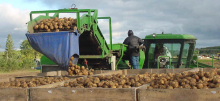
AgBioResearch Helps Propel Potato Industry
The Michigan potato industry is seeing significant returns from investment in Michigan State University research. Scientists are helping growers deliver chips and fries that stay local longer, cut costs, and keep hundreds of jobs in Michigan.

M-AAA Backs Research on High Oleic Soybeans, Driving ‘Once-in-a-Generation’ Gains for Michigan Dairy Farmers
MSU-led research shows how feeding dairy cows high oleic soybeans can cut feed cost, boost milk quality and spark economic growth — allowing one southwest Michigan dairy farm to add more than $1 per cow per day in income over feed cost.

Researchers Explore How Virtual Sports Aid Mental Health
Physical sports have long been known to help with anxiety and mental health. But can augmented and virtual reality sports games improve psychological well-being and reduce loneliness? Researchers at Michigan State University’s Department of Kinesiology say yes.

‘Wiggling’ Atoms May Lead to Smaller, More Efficient Electronics
Researchers at Michigan State University have figured out how to use a fast laser to wiggle atoms in a way that temporarily changes the behavior of their host material. Their novel approach could lead to smaller, faster and more efficient electronics — like smartphones — in the future.

New Research Could Advance Treatment of Brain Disease, Injury
MSU researchers collaborated with scientists from Rutgers University–New Brunswick to identify a previously unknown role for cypin in the communication between specialized brain cells called neurons.

Researchers Address Gap in Substance Use Disorder Treatment
A team of researchers from Michigan State University and community partners has conducted critical research to address gaps in treatment of substance use disorder in Michigan’s St. Clair County and the city of Port Huron.

CSE Researchers Add $1.16 Million in New Research
The College of Engineering is among Michigan State University’s top producers of research discoveries and commercialization that help build a diversified economy and generate jobs for Michigan and the Midwest. Three new National Science Foundation, or NSF, grants will add $1.16 million in research funding to the Department of Computer Science and Engineering.

Seeding the Field
Today, Arabidopsis thaliana is used in plant labs at Michigan State University and around the world. It's led to major discoveries in their labs and the MSU-DOE Plant Research Laboratory. And it all began with a husband-and-wife team who would help pioneer Arabidopsis research at Michigan State University.